Blog
Ten Years of DDD Europe, Eric Evans on Domain-Driven Design in the Age of LLMs
Posted on 2026-10-19 - 4 minute read
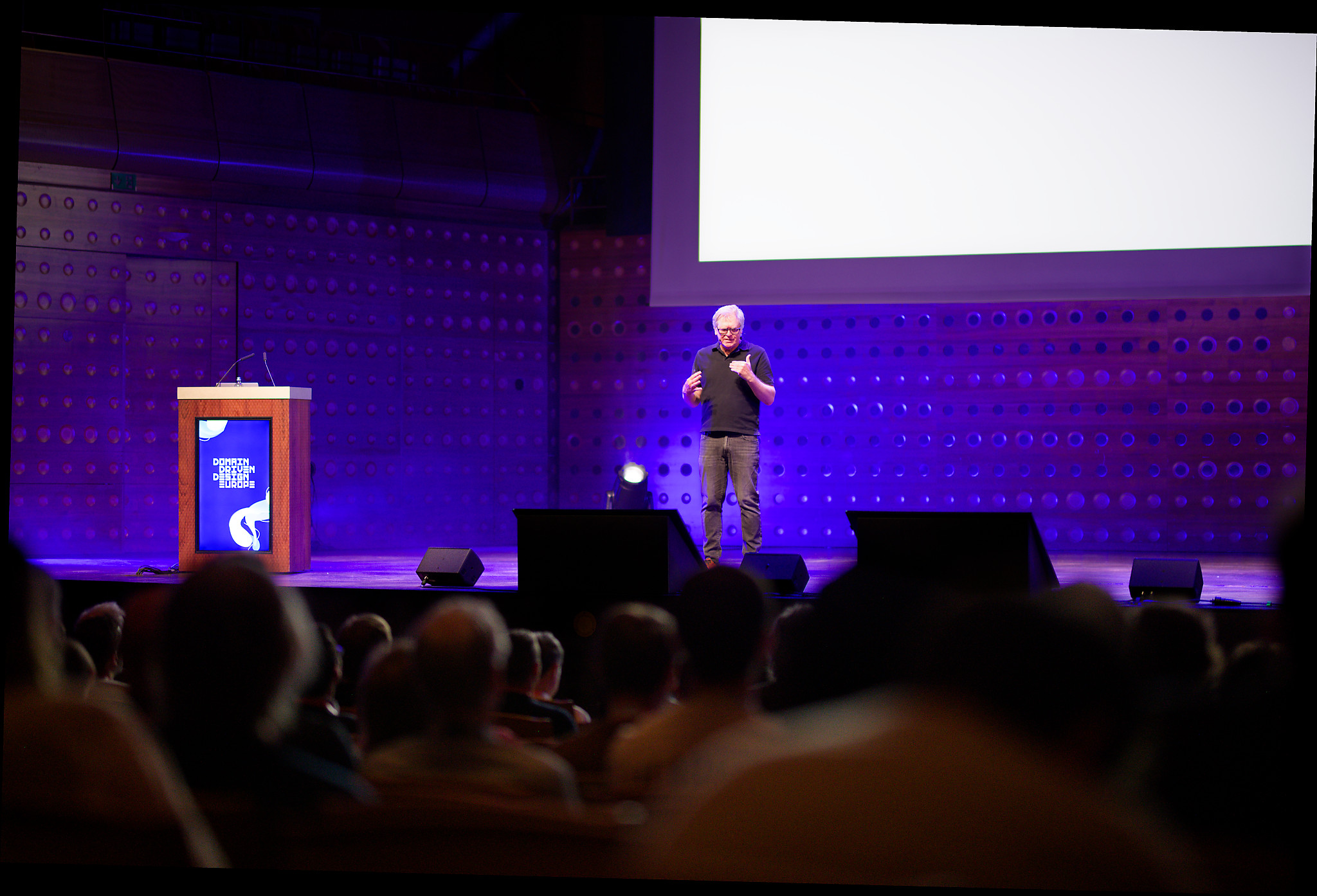
Opening DDD Europe's tenth edition, Eric Evans looked back on a decade that included a pandemic, political upheaval, and the rise of microservices, and forward to what he called the next big disruption: AI. His keynote was part reflection on community resilience, part account of a genuinely hands-on experiment applying LLMs to one of Domain-Driven Design's oldest open questions: how do you know your bounded contexts are actually right?
Curiosity over prediction
Evans opened with a reminder that hype and doom are two sides of the same coin, both resting on predictions of the future that nobody can actually make. Rather than trying to forecast where AI is headed, he argued for curiosity as a better guide: what do you find interesting, what fills you with wonder, and follow that. It's a notably calm framing for a topic that dominates every conference hallway conversation right now.
Building a domain language surveyor
The bulk of the talk walked through a genuinely novel experiment: a tool Evans calls the "domain language surveyor," built to empirically test whether a bounded context is actually behaving like one. The pipeline samples code and classifies which domain each chunk of code relates to, extracts the vocabulary actually used, and then compares that vocabulary statistically across different parts of a system, using measures like Jaccard similarity and cosine similarity of document frequency.
The point isn't abstract. If two parts of a system are supposed to be separate bounded contexts, their domain vocabulary should look different when compared this way. If it doesn't, that's evidence of language leaking across a boundary that's meant to be isolating it.
Testing it on a real system
Evans applied the technique to OpenMRS, a large, long-lived open-source healthcare records system with well-documented history, treating its history as a way to hypothesise a context map and then testing that hypothesis against the actual code. The empirical results broadly supported the hypothesis, with a few surprises worth investigating further.
What this means for Domain-Driven Design
Evans's closing argument is that DDD's core value doesn't diminish in an LLM-driven world, it changes shape. Domain models may increasingly be statistical rather than purely structural. Function boundaries become the place where verification gets attached to otherwise unpredictable LLM behaviour. And the practice of hands-on modelling, being close to the concrete system rather than only the abstract one, becomes harder to preserve when agents are doing more of the building, which is exactly why he thinks it matters more, not less.
Eric closed by turning back to the community itself: the reason DDD Europe survived a decade of disruption wasn't any one person's expertise, but the fact that people kept showing up to compare notes on what worked and what didn't.
What attendees said
I liked the content, it was very interesting to see a real project from such a distinguished presenter. It definitely inspired me to go and explore some of the ideas presented.
The approach of validating your context map and essentially validating that what you designed is what you implemented, is a very interesting topic. I'd want to try this myself in the near future.
This talk by Eric was good, as usual, and will serve as inspiration for own projects.
Watch the full keynote for the complete walkthrough of the pipeline, the OpenMRS case study, and Evans's reflections on what Domain-Driven Design needs to become.