Blog
AI Made Me Doubt Everything About Programming
Posted on 2026-08-26 - 5 minute read
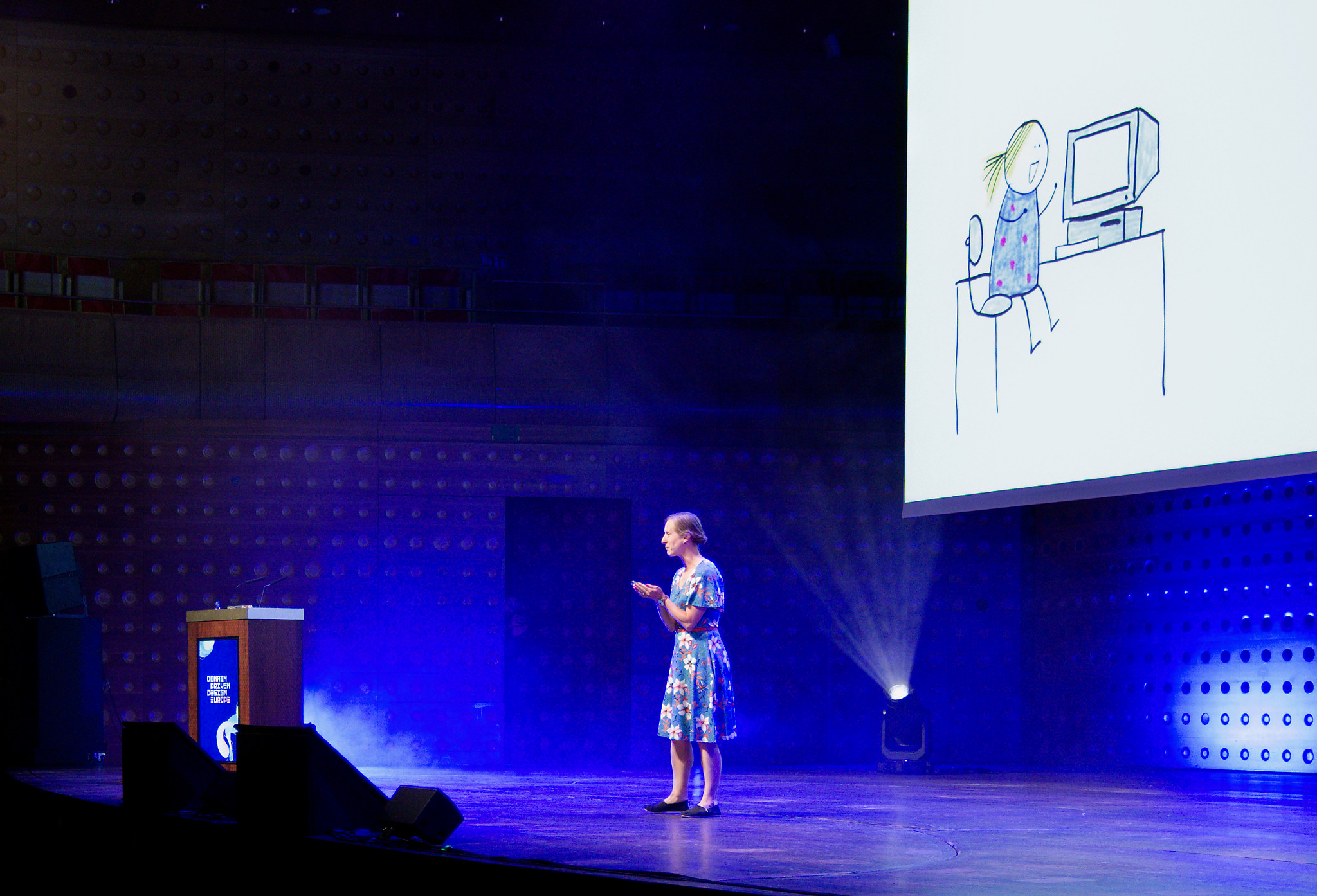
Felienne Hermans, creator of the multilingual programming language Hedy and professor of Computer Science Education, opened with a confession: she has fallen out of love with the field she has spent her career in. What followed was one of DDD Europe's most talked-about sessions, a personal, funny look at why programming culture rewards complexity and quietly punishes the opposite.
The spreadsheet problem
Hermans traced the pattern back to her early career studying spreadsheets, a tool millions of non-programmers use productively every day. Presenting that work at conferences, she was told repeatedly that spreadsheets are "not real programming." Years later, building Hedy, she met the same instinct in a different form. Colleagues who wanted to know why the work had to be so hard, as if difficulty were the point rather than a cost.
Her answer, borrowed from feminist epistemology and a 2016 paper on glacier research, is that fields quietly decide what counts as valuable based on what looks heroic to study, not what actually helps people. Glaciers that are hard to reach get more research funding than glaciers next to villages, even though the latter matter more to the people living there. Hermans argues programming works the same way: Haskell and proof assistants earn status, spreadsheets and localisation do not, regardless of impact.
A history programming doesn't like to tell
Hermans walked through John von Neumann's direct role in targeting the atomic bombs dropped on Japan, and IBM's sale of punch-card systems used to help administer the Holocaust. She draws a straight line from these uncomfortable chapters to today's unease about AI in warfare. Her point wasn't that individual technologists are culpable by association, but that computer science has a long-standing habit of treating itself as neutral when it demonstrably has never been.
Chess, and the trouble with what AI got good at
Drawing on historian Nathan Ensmenger's research, Hermans described chess as AI's "Drosophila," the model problem that shaped decades of research because it fit neatly into binary logic, not because it was the most meaningful thing to study. That same methodology, built for a game with clear right and wrong answers, has since been pointed at language and art, domains where "true or false" was never really the question. She's careful to note that chess itself offers a hopeful precedent: computers solved it decades ago, and human chess simply continued regardless, largely unbothered by the existence of a stronger machine.
What programming is actually for
Citing computer scientist Peter Naur's 1984 argument that real intellectual work means being able to explain and defend your reasoning, not just produce an output, Hermans questioned whether large language models do anything like this at all. She closed with a challenge to the room: if most programmers don't believe the software they build is making the world better, no amount of LLM-driven speed will fix that. The goal, she argued, isn't to reject AI outright, but to stop treating "harder" and "more automated" as automatically better, and to remember that programming, like chess, doesn't have to be used everywhere just because it can be.
What attendees said about this talk
It was a wake-up call and a call to reflection and action that the industry desperately needs.
This was exactly the right message for the right audience at the right time. Criticism with passion and humour through a personal story.
The presentation style was full of energy and walked through a really interesting and thoughtful story. I've never laughed so much at a talk before, yet it had a really serious and thought-provoking element too.