Blog
Why AI Agents Are Not Just Tools - Hila Fox on Socio-Technical Systems in the AI Era
Posted on 2026-09-16 - 4 minute read
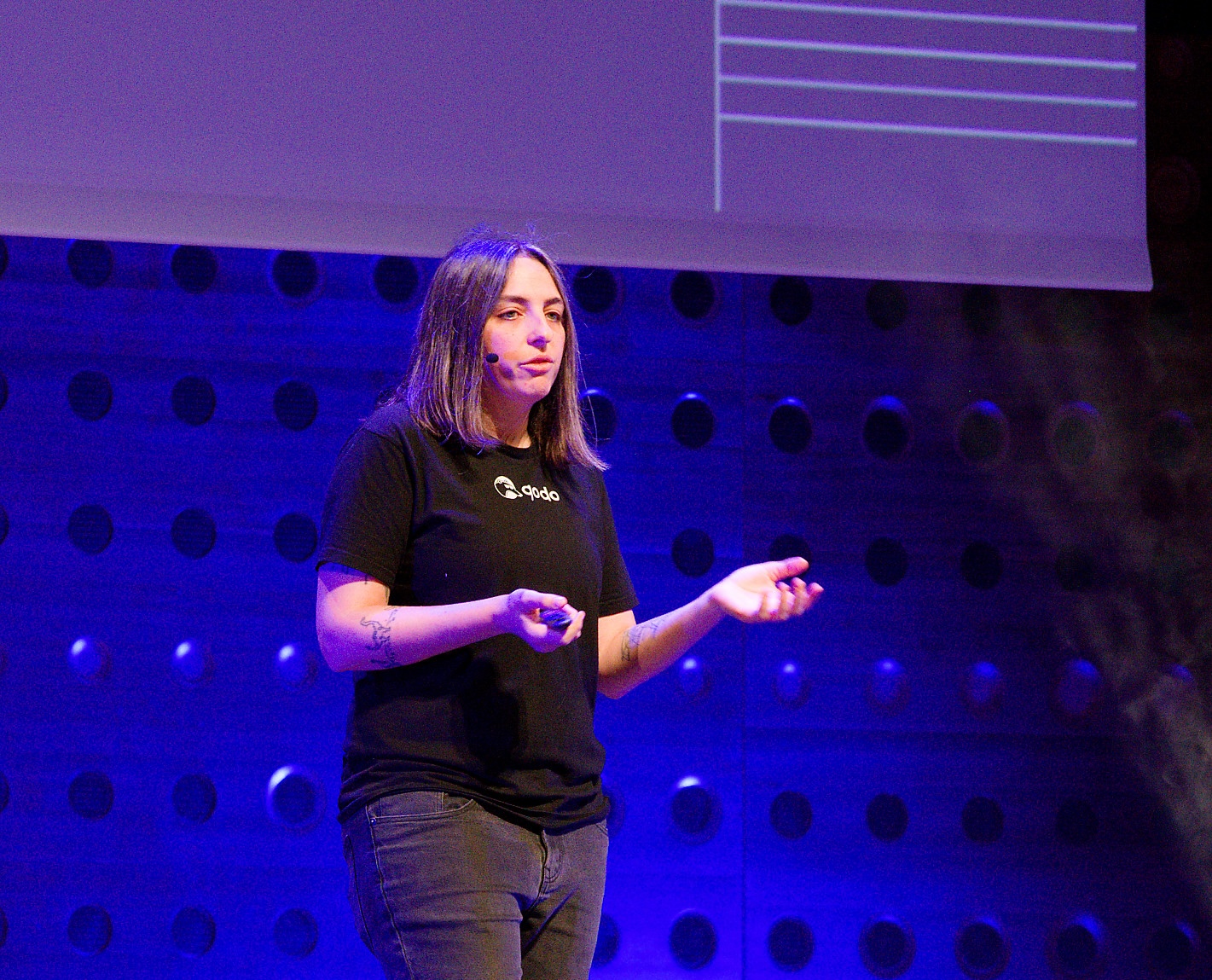
When we build AI agents, we tend to treat them as software: a technology layer bolted onto the org chart. Hila Fox, product manager at Kodo (and a Domain-Driven Design practitioner since long before AI agents existed), argues that this framing is the problem. In her DDD Europe talk, "Socio-technical Systems in the AI Era," she makes the case that AI agents are new socio-technical actors in their own right, not tools we can simply drop into existing org-chart boxes and expect to work.
Agents mirror the organisation, not the org chart
Fox opens with a reminder every Domain-Driven Design practitioner will recognise: org charts lie. The way work actually gets done rarely follows the lines on the diagram. Conway's Law tells us why: any organisation that designs a system produces a design that mirrors its own communication structure. She argues that dropping an AI agent into a box on that diagram does not equal automating that process. You can’t automate the informal, undocumented, deeply human way that process actually works, of which some parts you would never want to be automated anyway: the colleague who has to be looped in for political reasons, the team that quietly does its own thing because asking permission is slower than asking forgiveness.
Her claim: we are automating our organisational illnesses into our agents, and when the result is a bad decision, it is not the agent's fault. It is ours, for building it that way. System fragmentation follows naturally: organisational silos become agent silos, and organisational restrictions become decision limitations baked permanently into the system.
Context is the new bounded context
The talk's central argument turns on what Fox calls the new building block of our systems: context. Just as Domain-Driven Design gave us the bounded context as an anchor for managing complexity, Fox argues that in the AI era, context (the data, the history, and tacit knowledge an agent needs to act well) plays the same role. She walks through the layers of context a system needs, from a single session to team context, project context, and organisational context, and why simply throwing more context at a large language model does not work. Problems such as lost-in-the-middle attention loss, context rot, and needle-in-a-haystack retrieval failures all show up as the same symptom to users: hallucination. From here, she introduces context engineering as the discipline organisations now need, and protocols such as MCP for exposing context dynamically across a system, alongside emerging agent-to-agent communication standards.
Poorly designed context boundaries, she warns, lead to what she calls context hell: the same mess that organisations created with data lakes, replayed at the agent layer.
From deterministic software to reasoning systems
Fox frames a second transformation running alongside the organisational one: the shift from predefined, deterministic software to systems that reason. Where engineers once had to define every if/else branch in advance, agents (given the right context) can now handle cases nobody explicitly programmed for. This changes how we interact with systems too, moving from command to intent, from sequential to parallel work, and from micromanagement to oversight, each with real benefits and real new risks, including burnout from keeping up with tools that shift monthly rather than yearly.
What this means for Domain-Driven Design practitioners
Fox's closing framework is simple: defend, evolve, redesign.
- Defend the architectural fundamentals that still hold, twenty years of hard-won boundary-setting does not go in the bin just because AI arrived.
- Redesign around the organisational impact agents actually have: the suboptimal communication patterns, team structures, and coupling that agents will surface whether you plan for it or not.
- And evolve the skills and roles needed as AI agents become genuine new actors in the socio-technical system.
What attendees said about this talk
This talk gave a good overview about how DDD concepts relate to LLMs and what to look out for. It felt like another layer on my foundation.
The smells, what to watch out for …
This is a highly relatable topic. Food for thought.